NO. 2027 · On air
Back to the shelfMilsch
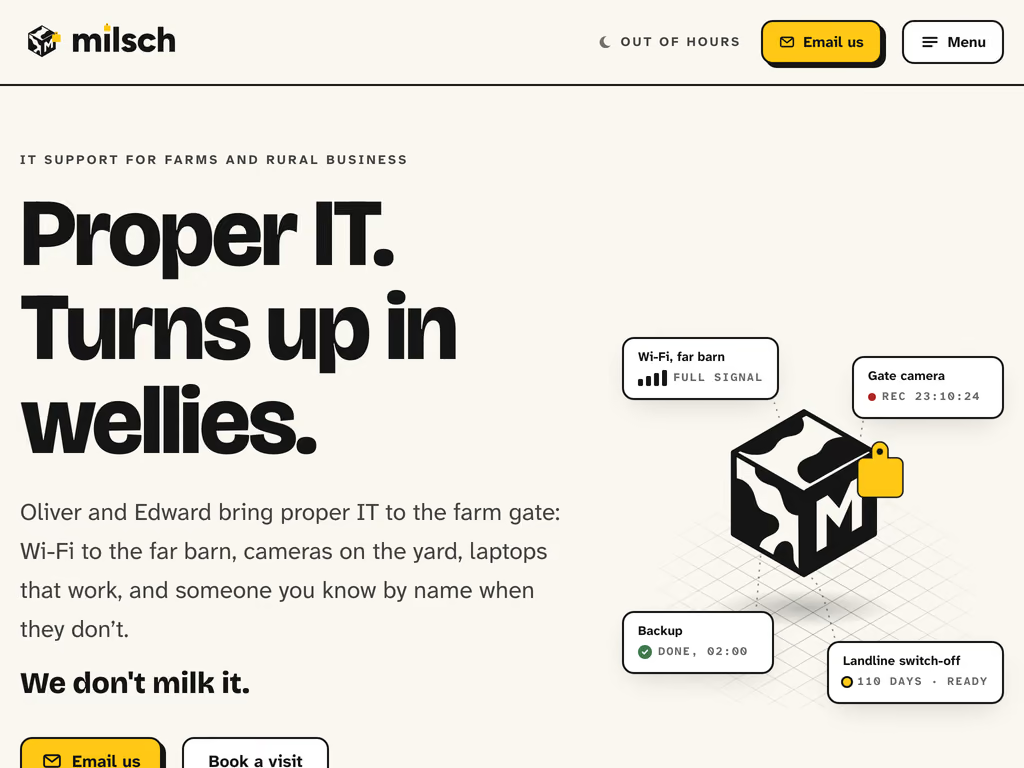
A brand and website for Oliver and Edward's IT business for farms around Malmesbury: every price on the page, and tools that work on one bar of signal.
Specification
- Client
- Milsch, Oliver and Edward
- Year
- 2026
- Role
- Brand, Design, Build, Copy, Search
- Disciplines
- Brand identity, Web design, Local SEO, Content design, Working tools
What they arrived with
Milsch is Oliver and Edward, and yes, it is the same Oliver who runs this studio. Oliver ran IT at Omitec Vehicle Diagnostics and Continental, did design and consulting for Tesla, and was head of IT and design at Online Legal Services. Edward wrote software at Sherston Software, managed print at the Complete Product Company, and now works at Park Lane Press in Corsham. Between them they set out to take proper IT to the farms and rural businesses of North Wiltshire, the southern Cotswolds and Bath, which run on technology now, from the parlour computer to the camera on the gate, and are served by almost nobody who has had mud on his boots. The project began with a name, Milsch, a line, We don't milk it, a domain, and no website at all.
The real constraint
A farmer looks a business up on a phone, in a yard, on one bar of signal, and decides in a moment whether this is someone to call out. Trust is the whole job: the same faces every time, people who turn up when they say, tell the truth about what is worth doing, and do not send a bill that makes anyone wince. There are two dates on the farm office wall that make this winter the moment to act, the landline switch-off on 31 January 2027 and Making Tax Digital from 6 April 2027, and a business of two is out on jobs all day, with nobody in an office waiting by a phone. And the name is a pun, which is a gift to be handled carefully: one cow joke too many and nobody trusts you with their CCTV.
The thinking
- Make a farmer feel they already know Oliver and Edward before they get in touch. The promise is the same two people every time, and their careers are told as two cattle passports, each with an ear tag and a record of movements, because every animal in Britain has one and it seemed only fair. Getting in touch is an email or a two-minute booking, and a line at the top of every page says whether they are working today, out of hours or away, and when the reply will come.
- Show, not tell, that they are very good at this. The site does real work rather than describing it. Walk the yard is a drawn farm with eleven stops and what goes wrong at each; Check your signal takes a postcode and gives a plain verdict on every network; the barn link planner works out whether a wireless beam will reach the barn, or whether it wants a taller pole or a cable; Scam or not? is ten messages to spot. Each one is a small proof that they know what they are doing, before anyone has had to ask.
- The price before the work. Most IT firms make you ring for a price. Every one of Milsch's is on the page, from a visit to the monthly plans, and the common jobs are priced so you can tick what you need and see a rough total, because We don't milk it has to be something you can check.
- A pun budget. One cow joke per page, at most. The brand is playful in its mark, its illustration and its features; the words stay useful, and nobody is ever told that even they could manage it.
The build
The mark is the Holstein box: a computer box printed like a Holstein cow, black on its right face with a capital M, and a yellow cattle ear tag hanging from the corner, a nod to the cow-print computer boxes of the nineties, decided after seven rounds of sheets. The palette comes with it, milk and Holstein black, the ear tag's yellow and a pasture green, and the type is a grotesque with some character for the headlines and a face designed to be legible for everything else. The yard is drawn, not photographed, so the stops can light up and the night can fall. The booking form asks what is playing up and when suits, with Not during milking as a real option, and asks for the farm's name and the nearest village rather than a gate code; the notification and the confirmation it sends share Milsch's own layout. The farm IT card fills in on screen and prints on one sheet for the office wall, and a laminated one is left at every job. Malmesbury, Tetbury, Cirencester and Bath each have a page, the areas page draws the twenty miles they cover with every village's distance, and eight guides answer the questions one farm has and ten others will. The whole thing is built to be quick on a poor signal, tracks nobody, counts visits only with permission, and carries the structured data that lets a search engine, or an assistant asked for IT help on a farm near Malmesbury, say exactly who they are. The studio runs it, booking emails included.
Contact sheet
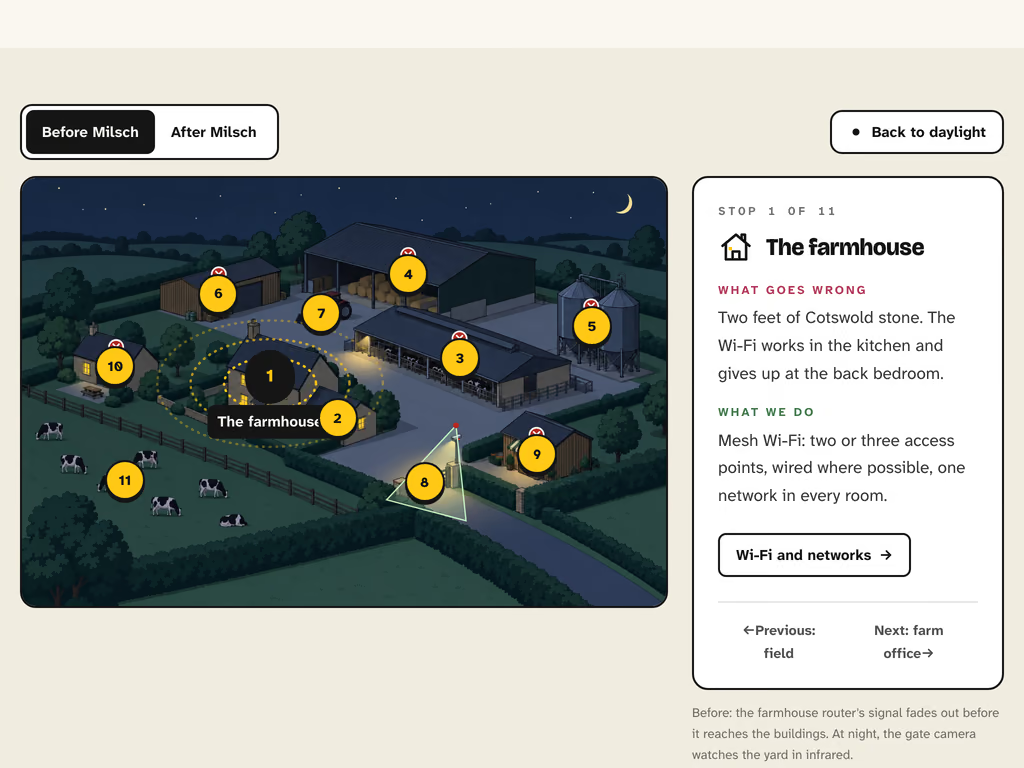
1 · The yardA farm you can walk round: eleven stops, what goes wrong at each, and a switch that shows it fixed. 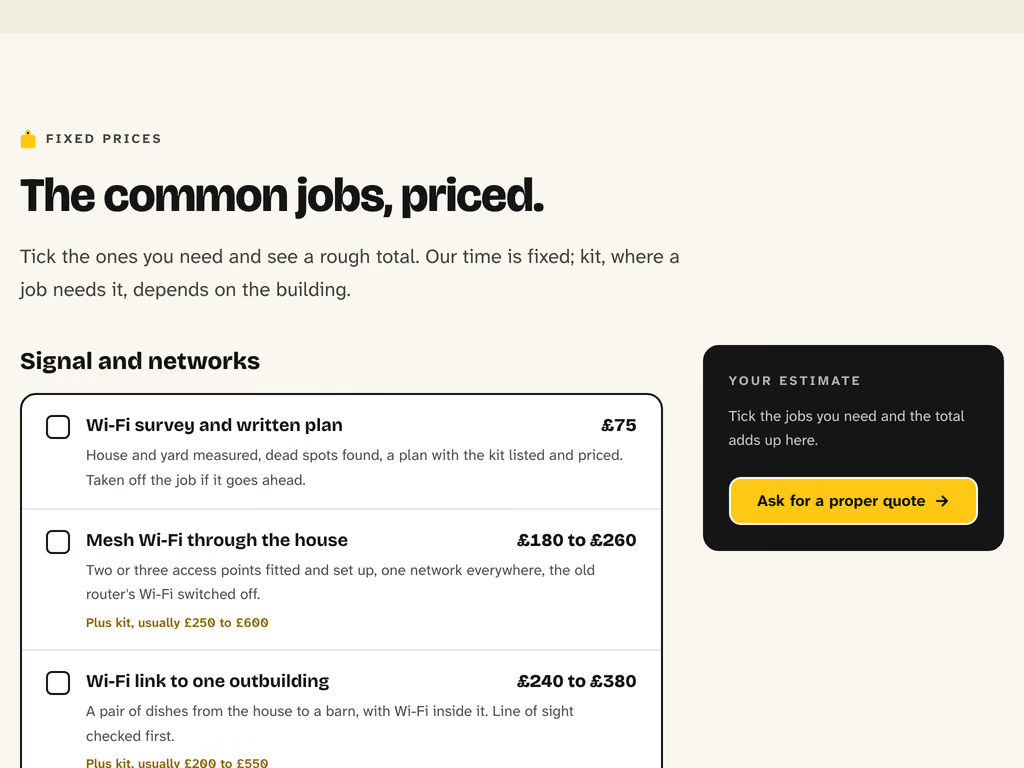
2 · PricesEvery price on the page, and the common jobs priced so you can tick what you need and see a rough total. 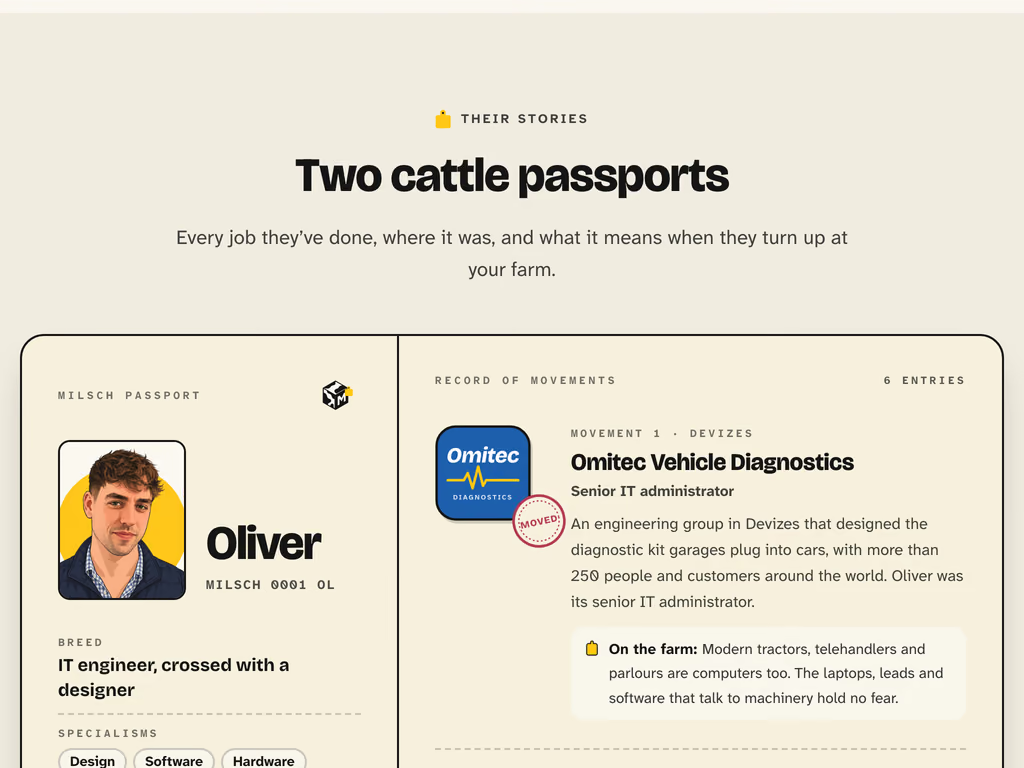
3 · PassportTwo careers as two cattle passports, each with an ear tag and a record of movements, because every animal on a farm has one. 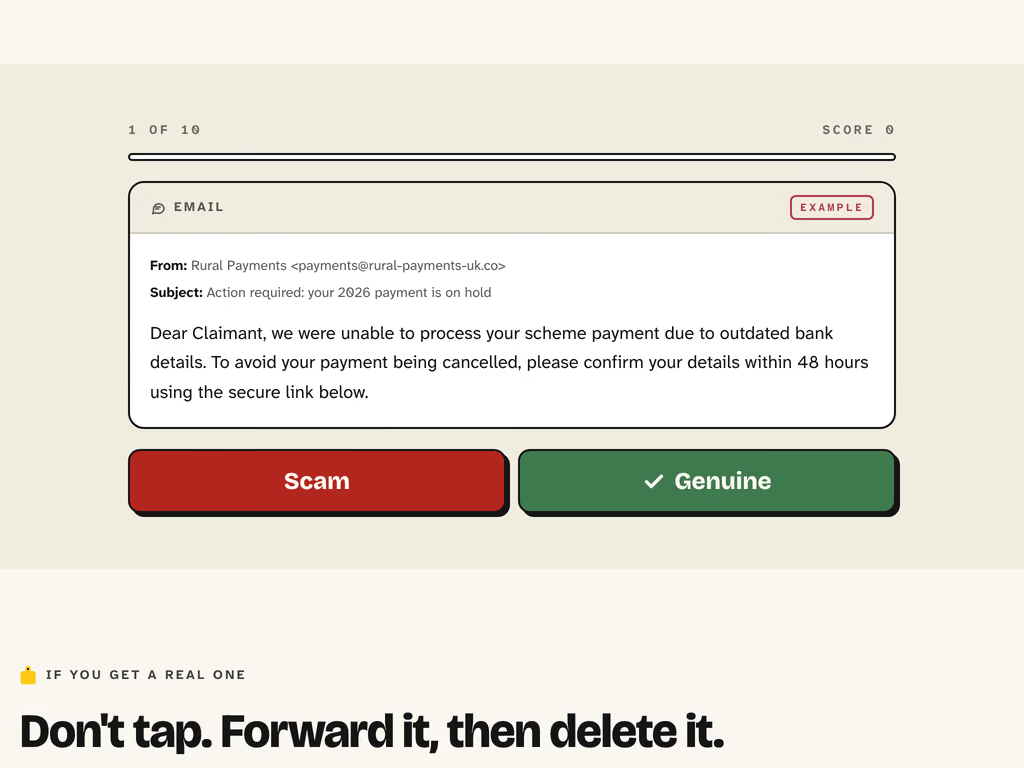
4 · ScamsTen made-up messages modelled on the real ones farms get, one at a time, with the giveaways shown once you answer.


Kept simple, on purpose
Contracts, or a fee for the sake of itPrices you have to ring up forRemote access before you have been in touchA call centre, or a chatbotA box on the form for your gate codeStock photographs of somebody else's farm
The system
Palette
- Ground#FAF7F0The page
- Ink#15151517.1:1 on ground
- Text#1E4A389.4:1 on ground
- Fill#FFC814Filled blocks
- Fill ink#15151511.8:1 on fill
- Edge#1E4A389.4:1 on ground
Type
- Headlines
- Bricolage Grotesque
- Text
- Atkinson Hyperlegible Next
- Labels
- Atkinson Hyperlegible Mono
Working model
Six IT words, in farm English
Access point. A small box, often on a ceiling or wall, that makes Wi-Fi where the router can't reach. Wired back to the router for the best results.
Backup. A second copy of your files, kept somewhere else, that you've actually tested you can get back.
Digital Voice. Phone calls carried over your broadband instead of the old copper line. Where every UK landline is heading by January 2027.
Failover. A second connection, often 4G, that takes over by itself when the main one drops, and hands back when it returns.
Full fibre. Broadband on a glass fibre all the way to the building. The fastest and most reliable kind, where it has reached.
Firewall. A gatekeeper between your network and the internet, letting your traffic out and keeping strangers out.
The whole glossary, A to W, is on the site, in a sentence each, including the word jargon.
What happened
Planned on the Monday, 12 October 2026, and on air by the Tuesday at milsch.co.uk, with the booking form, the tools and the guides all working from the first day. The bookings, the visits and the yards with a signal in every corner will be counted here once there are enough of them to mean something.